Quantity over quality
If you mention statement x in the news for 1 week and most people believe it, does it make it more true?
What if we increase that period to be 2 weeks, 2 months, 2 years? Can you question something that has been stated 15 thousand times by 40 different organizations over a certain period? If public perception is based on what is stated the most, then:
- how easy it is to game that system?
- will that strategy work out in the long run?
How many times someone needs to intentionally lie, before people maybe, just maybe start to consider the possibility that they could be a bad actor?
Measurement as indication
It's quite easy to skew the perception of an event. One way to do it is by changing how you measure its impact.
Event x occured to y number of people.
Event x occured to y % of the people.
Proceed by flip flopping between percentages and count when it validates the messaging better. Exaggerate the impact of event x by using count when percentage doesn't have the appropriate impact. Switch to percentages when you need another impact. Or vice versa.
Examples of this could be:
Oh, did you hear about how many people were involved in event x? 172!
Seems like event x wasn't a big deal. Only 0.002% of people were involved in it.
0.002% can be the same as 172 people. Same numbers, different perception. The type of measurement used will always be the one that has the most desired impact. Never the opposite.
Even easier method of skewing the perception of an event is by not mentioning it at all. It's very hard to dispute things that stop getting the previous spotlight on them. Mentioning them is a losing game in most cases.
Well, if they don't mention event x, it stopped being a problem, right?
Gell-Mann Amnesia
“Briefly stated, the Gell-Mann Amnesia effect is as follows. You open the newspaper to an article on some subject you know well. In Murray’s case, physics. In mine, show business. You read the article and see the journalist has absolutely no understanding of either the facts or the issues. Often, the article is so wrong it actually presents the story backward—reversing cause and effect. I call these the “wet streets cause rain” stories. Paper’s full of them. In any case, you read with exasperation or amusement the multiple errors in a story, and then turn the page to national or international affairs, and read as if the rest of the newspaper was somehow more accurate about Palestine than the baloney you just read. You turn the page, and forget what you know.” > – Michael Crichton (1942-2008)
Campbell's Law
"The more any quantitative social indicator is used for social decision-making, the more subject it will be to corruption pressures and the more apt it will be to distort and corrupt the social processes it is intended to monitor."
If inflation and GPD shows how well the economy is doing, then how easy it is to fudge those numbers? 2008 showed that, while the banks and most economists might not be the best at avoiding or creating bubbles, they're still exceptionally good at abstracting simple metrics and turning them into these 5D chess games with boxing and water skiing mixed in the game rules.
Continue wrapping risk in 7 nested abstractions so that it disappears and cannot be debugged, and then be surprised when it blows up in your face.
Selective attention
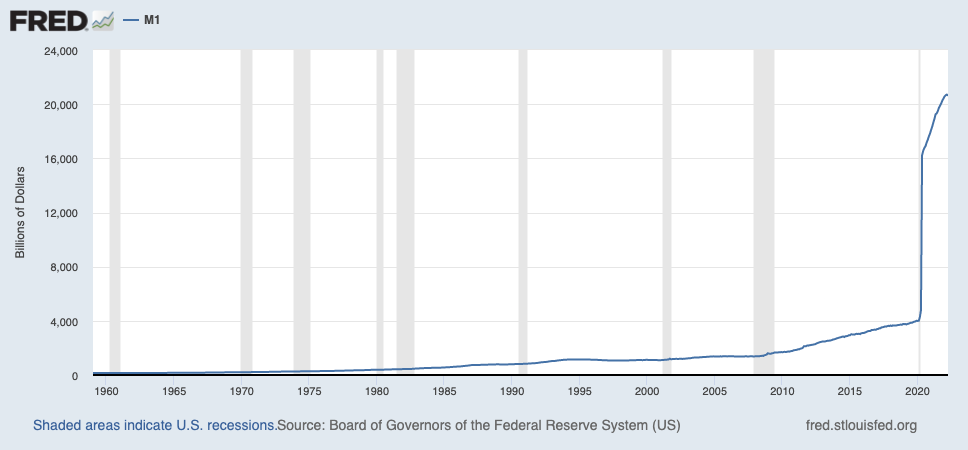
You will continue seeing these Hahaha, Crypto markets are a bubble type of headlines. Are these arguments / headlines completely wrong? Debatable. But it's interesting that the same people who seem to be experts in financial markets forget to mention these graphs.
M1 Money Supply
M2 Money Supply
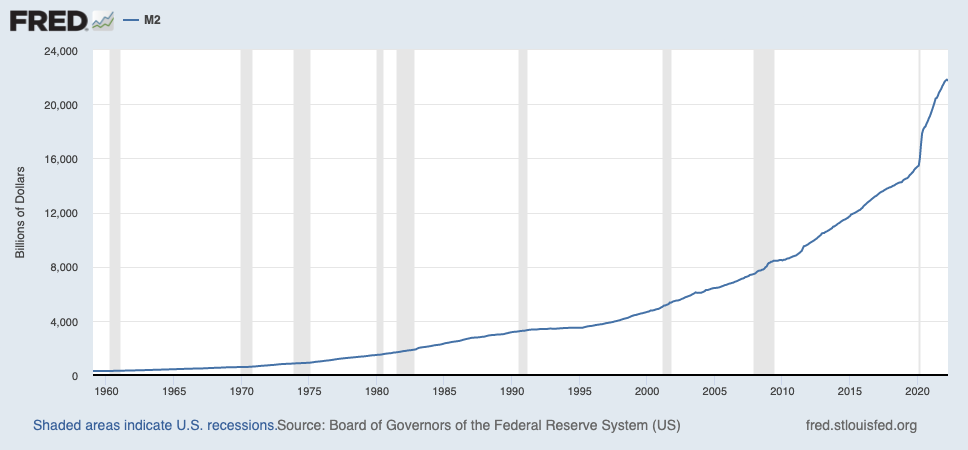
Remeber that the 2008 crash is also included in the graph.
Do Modern Monetary Theory people look at these graphs and don't see a potential problem?
Zooming into one sector and calling it a bubble seems a bit disingenuous in this case. If the authors of these articles pay so much attention to financial markets, they also most probably pay at least some attention to the M1 & M2 graphs. Or have checked them out at least once in the past year. But don't seem mention them. So is it disingenious to cherry pick one market and call it a scam, while not mentioning the global state of the economy?
This is like making fun of Jim because he burned his hand, but then not asking who set the house on fire.
Hypernormalizing rage bait
I'm not on twitter, but as I understood that place is on the same level of shitshow as reddit. Which is an accomplishment by itself.
But anyways, is that shitshow caused by:
- regular people with regular takes
- the outspoken group that are most vocal about their opinions?
It seems like the following scenario repeats over and over again.
Hypernormalize the opinions of 0.001% of the user base (17000 retweets) that push rage bait or other toxic stuff, presenting them as the average opinion of the silent majority.
Once there is a new event x, write a news article saying that a lot of people (which can be 17000 retweets) are angry about that event.
Go to the front page of reddit and count how many of the top 40 posts are content that is designed to make your chest feel heavy and sway your emotions in a certain direction. The same will also apply to most of the popular news sites. They're not there to inform you. They're there to make you mad. Scared, when needed.
Current news are more of a bureaucratic version of reddit. Shitposting for clicks. Shitposts on reddit are not really taken seriously, but shitposts on news sites ... are?